How to Build Topical Authority for AI SEO
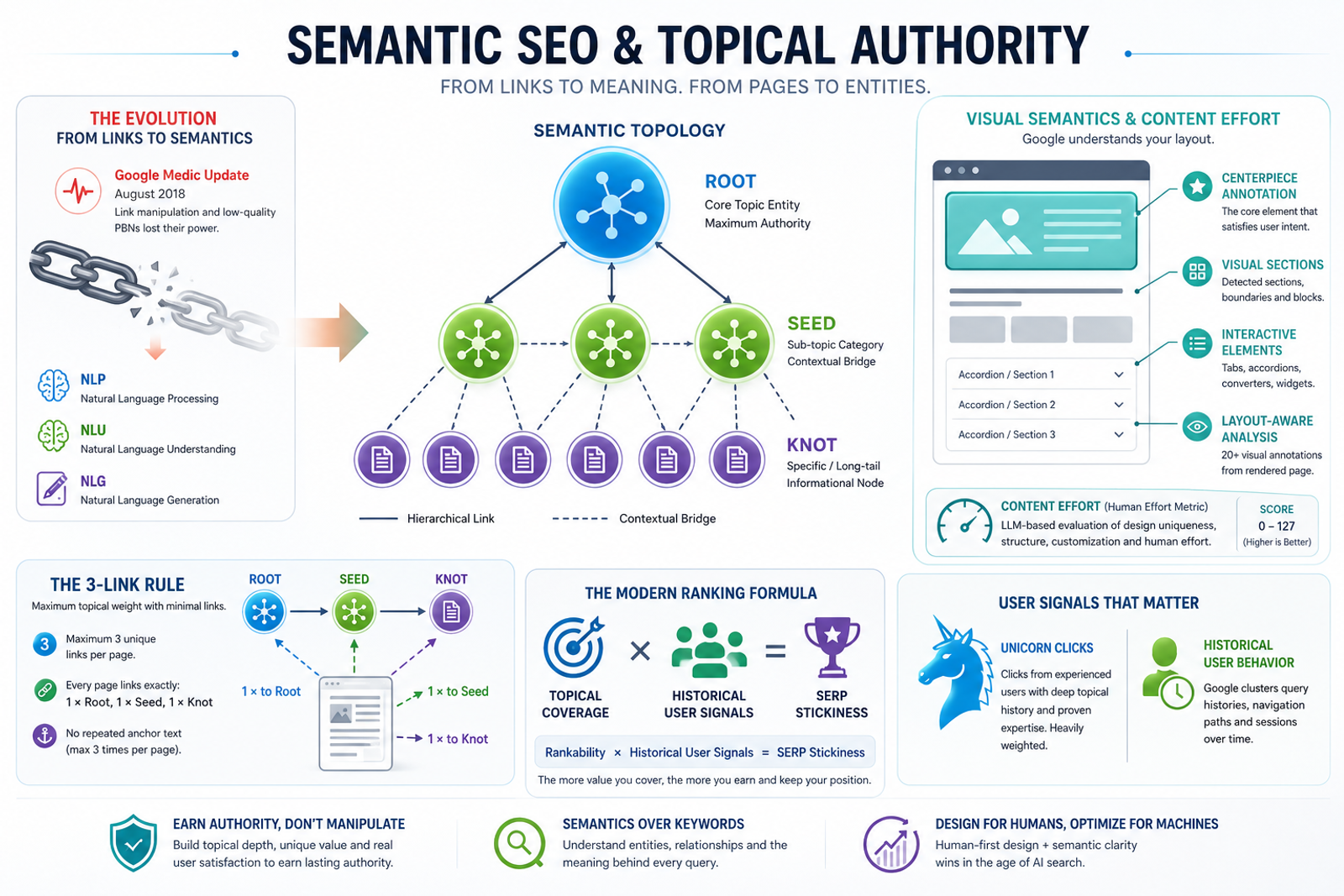
How to Build Topical Authority for AI SEO
Topical authority for AI SEO is the trust score search engines and AI answer engines assign to a site when its internal link structure, page layout, and historical user data prove comprehensive expertise on one topic — not when the copy simply claims it. Google stopped rewarding link volume and keyword density years ago. What replaced them is a set of mechanisms most SEO guides never name directly: Rank Merge, Now Boost, Root-Seed-Knot linking, the Rule of Three Links, Unicorn Clicks, and Content Effort. Each one is documented below, with the specific numbers and sources behind it.
What Caused the Shift From Links to Semantics in SEO?
The August 2018 Google Medic Update caused the shift from link-based ranking to semantic, NLP-driven ranking. Before Medic, link-heavy private blog networks — some running 3,000+ sites in a single niche — could out-rank genuinely authoritative pages just by manipulating backlink volume. Medic broke that model overnight.
What Medic exposed was a longer-term investment Google had already made. Patent research from analysts like Bill Slawski and Shawn Anderson showed Google's capital shifting away from classic PageRank-style popularity metrics and toward Natural Language Processing, Natural Language Understanding, and Natural Language Generation. The practical effect: instead of counting how many links point at a page, Google started evaluating what a link *means* — the semantic connection between the source page, the target page, and the exact anchor text used to bridge them.
What Is Rank Merge in Google's Ranking System?
Rank Merge is the mechanism Google uses to reconcile link-based authority with real-world search popularity. Academic and reference sites often carry excellent backlink profiles but thin traffic. Consumer-facing sites often see millions of visits with almost no external links. Rank Merge blends the two signals so neither type of site is unfairly penalized for lacking the other's strength.
What Is Now Boost?
Now Boost is the evolved version of Rank Merge that appeared in more recent Google data leaks, combining topicality, backlinks, real-world popularity, and historical navigation or query-log data into one signal. Where Rank Merge balanced two inputs, Now Boost adds a third and fourth: how users have actually behaved around a topic over time, and which query paths led them there. A site can satisfy Rank Merge's balance and still lose on Now Boost if its historical engagement data is thin.
How Does the Root-Seed-Knot Internal Linking Architecture Work?
The Root-Seed-Knot architecture organizes a topical map into three link tiers: a Root page (the central entity), a Seed page (the sub-topic category), and a Knot page (the specific long-tail article). Every Knot links up to its Seed, and every Seed links up to its Root, forming a contextual bridge at each step rather than a flat, everything-links-to-everything structure.
Koray Tuğberk Gübür tested this architecture on four websites by stripping traditional navigation almost entirely — logo-only headers, bare footers — so that internal link weight flowed exclusively through the body text of the main content. All four sites ranked. The takeaway isn't "delete your navigation." It's that when body-content links carry the weight instead of decorative sitewide menus, the hierarchy Google sees matches the hierarchy you actually intend.
What Is the Rule of Three Links?
The Rule of Three Links limits each page to a maximum of three unique anchor texts, one each pointing to its Root, its Seed, and its Knot. No anchor text repeats more than three times on a single page, regardless of how many opportunities exist to link it. This constraint does two things at once: it keeps the main content's own subject matter as the most prominent element on the page, and it stops search engines from diluting an anchor's semantic weight by spreading it across a dozen near-identical links.
If a page needs a fourth relevant internal link, the fix is picking a different, equally specific anchor phrase — not repeating one that's already been used three times.
What Are Unicorn Clicks?
A Unicorn Click is a search result click from a user with a long, documented browser history of searching within that same topic. Google weights it far higher than a click from an anonymous or newly registered account. Cookie-less CTR manipulation and freshly created accounts no longer move rankings, because Google filters low-trust query actions out of the click signal entirely. An established professional who has spent years searching SEO terms and clicking a specific type of result carries more ranking influence with a single click than dozens of unfiltered ones.
How Do Topical Coverage and Historical Data Determine Rankability?
Rankability and SERP stickiness are the product of Topical Coverage multiplied by Historical Data — comprehensive coverage alone isn't enough if a competing page has years of positive navigation history behind it. Displacing an incumbent that Chrome users have trusted for years requires two things simultaneously: broader, more complete coverage of the topic than the incumbent has, and a distinct enough experience to trigger a fresh quality re-evaluation from Google rather than a routine re-crawl.
What Is Content Effort in Google's Ranking Algorithm?
Content Effort — labeled `ContentEffort` in a 2024 Google API leak — is an LLM-based quality score on a 0-to-127 scale that measures how much human effort went into a page's structure and design, not just its text. It's the algorithmic counterpart to the "Total Human Effort" signal already described in Google's Quality Rater Guidelines. Google's models render snapshots of a page's layout and evaluate how customized, structured, and deliberately designed it looks, independent of the words on it.
Layout clustering systems such as PubLayNet play a role here: sites running an unmodified, default CMS theme — a stock GeneratePress build, for instance — paired with clearly automated text get flagged as low-effort and mass-replicated, even if the underlying content is factually accurate.
What Is Centerpiece Annotation?
Centerpiece Annotation is the specific web element on a page that Google identifies as directly serving that page's core intent and function. Google renders pages and extracts more than 20 distinct visual annotations — sentence boundaries, section blocks, interactive tabs, accordions — to locate this element, per the framework described in the paper "Layout-Aware Multimodal Document Understanding" (Alexander Nayork and Michael Bendersky).
A unit-converter site demonstrated the effect at scale. The interactive converter tool originally sat in the middle of the page, positioned there deliberately to maximize ad impressions before a visitor reached it. Moving that same tool to the top of the page — making it the unmistakable Centerpiece Annotation — took daily clicks from 2,000 to 30,000. The layout change alone prompted Google to re-crawl and re-evaluate the entire site from scratch, because the page's actual function was finally where the rendering algorithm expected to find it.
How Do You Build Topical Authority for AI SEO?
Building topical authority for AI SEO means treating all six mechanisms above as one system rather than six separate tactics:
- Map your content into Root-Seed-Knot tiers before writing a single page, so every future article already knows which Seed it belongs to and which Root it ultimately supports.
- Enforce the Rule of Three Links in your CMS or editorial checklist — one Root anchor, one Seed anchor, one Knot anchor, no repeats past three uses.
- Audit your layout for a Centerpiece Annotation, not just your copy. If the page's core function is buried below ads or filler sections, Content Effort scoring will treat it as low-effort regardless of word count.
- Earn Unicorn Clicks instead of manufacturing CTR by building genuine topical depth that repeat, topic-literate searchers choose over the incumbent.
- Let Now Boost work in your favor by pairing topical coverage with real engagement — time on page, return visits, and query paths that show users treating your site as a destination, not a bounce.
None of these replace comprehensive topic coverage or backlinks. They determine whether that coverage actually gets recognized once it exists.
FAQ
How many internal links should a page have for topical authority?
Each page should carry exactly three unique anchor texts under the Rule of Three Links: one to its Root page, one to its Seed page, and one to its Knot page, with no anchor repeated more than three times on the same page.
What is Content Effort in Google's leaked API documentation?
Content Effort (`ContentEffort`) is an LLM-based score on a 0-to-127 scale that evaluates a page's layout, structure, and design customization as a proxy for human effort, separate from the quality of its text.
Do backlinks still matter for topical authority in AI search?
Yes — Rank Merge and its evolved form, Now Boost, both use backlinks as one input, blended with real-world popularity and historical user navigation data rather than counted in isolation.